Solar Powered EV Charger for Home: Setup, Cost & ROI
Elon Musk once said, “The sun is the ultimate source of energy, and it’s going to be the future of energy.” Many homeowners are now using solar energy for their electric vehicle (EV) charging systems.
Installing a solar powered EV charger can cut down your electric bill. It creates a system where your roof powers your home and car. This not only saves money but also lessens your need for the grid.
Thinking about this innovative solution? You’ll want to know about the setup, costs, and return on investment (ROI). Using the sun’s power lets you drive your EV while saving money and the planet.
Table of Contents
Understanding Solar Powered EV Chargers
More people are choosing electric vehicles to cut down on carbon emissions. Solar-powered EV chargers are a key part of this trend. They use sunlight to charge your car.
What is a solar powered EV charger?
A solar-powered EV charger uses solar panels to charge your car. It can charge directly or store energy in a battery for later. This makes using solar energy efficient and cost-effective.
How do they work?
Here’s how a solar-powered EV charger works:
- Solar panels turn sunlight into electricity.
- The electricity goes to a solar inverter, which changes it to AC power.
- You can charge your car directly or save energy in a battery for later.
Using a solar-powered EV charger saves money and helps the environment. Let’s look at how it compares to other charging methods:
| Charging Method | Cost | Environmental Impact |
|---|---|---|
| Grid Electricity | Variable, often higher | Higher, dependent on grid energy mix |
| Solar Power | Lower, after initial investment | Lower, renewable energy source |
Choosing a solar-powered EV charger cuts costs and helps the planet. As technology improves, these chargers will become even more appealing to electric vehicle owners.
Benefits of Using a Solar Powered EV Charger
Thinking about charging your EV at home? A solar-powered charger is a great choice. It uses the sun’s energy to charge your car.
Cost Savings in the Long Run
Using a solar-powered EV charger can save you money over time. It lets you use solar energy instead of the grid. This cuts down your fuel costs.
The first cost of a solar-powered charger might seem high. But, the savings later on are big. As energy prices go up, making your own energy is even more valuable. With a solar charger, you save on fuel and protect against price increases.
Environmental Impact
There’s also a big environmental plus to using a solar-powered EV charger. It cuts down your carbon footprint a lot. This is key as we all try to reduce our impact on the planet.
Choosing solar for your EV charger is good for the planet. It makes your car’s journey as green as possible. By going solar, you help make our environment cleaner and support renewable energy.
Assessing Your Home’s Solar Potential
Knowing your home’s solar potential is key to getting the most out of a solar powered EV charger. To figure out if a solar panel system can charge your electric vehicle well, you must look at a few important things.
Evaluating Roof Space and Orientation
First, check your roof’s size and where it faces. How much sunlight your solar panels get depends on their direction and if they’re in the shade. The best spot for solar panels is south to catch the most sunlight all day.
When looking at your roof, think about:
- The size of your roof and room for solar panels
- The direction and tilt of your roof
- Any shadows from trees, buildings, or other things
Understanding Local Solar Irradiance
Another big factor is knowing the local solar irradiance. This is how much solar energy hits the Earth in your area. It tells you how much power your solar panels can make.
To find out the local solar irradiance, you can:
- Look at solar maps or databases for your area
- Use online tools or apps to guess your solar potential
- Talk to a solar installer who can check your place and give advice
By checking your roof and understanding local solar irradiance, you can pick the right solar panel system for your home. This will make sure your best home ev charger solar powered works well. It will save you energy and help the planet too.
Choosing the Right Solar Panels
The success of your solar EV charging system depends on the solar panels you pick. When setting up a green home charging station, it’s key to know the different solar panels and their features.
Types of Solar Panels Available
There are many solar panels on the market, each with its own benefits. The most well-known types are:
- Monocrystalline Solar Panels: These panels are very efficient and last long. They’re made from a single crystal.
- Polycrystalline Solar Panels: These panels are made from many silicon crystals. They’re cheaper than monocrystalline panels.
- Thin-Film Solar Panels: Thin-film panels are not as efficient but are flexible. They can be used in many ways.
Factors to Consider When Selecting Panels
When picking solar panels for your eco-friendly solar EV charger, think about a few key things. This will help you choose the right ones.
| Factor | Description | Importance |
|---|---|---|
| Efficiency | The panel’s ability to turn sunlight into electricity. | High |
| Durability | The panels’ lifespan and how well they handle the environment. | High |
| Cost | The upfront cost of the solar panels. | Medium |
By looking at these factors and knowing about the different solar panels, you can choose wisely. This will help meet your energy needs and support a sustainable green home charging station.
Solar Inverters: The Heart of Your Charging System
Solar inverters are key in turning DC power from solar panels into AC power for your home and car. This change is vital for using the energy from your solar panels to charge your EV.
What is a Solar Inverter?
A solar inverter is a crucial part of your solar EV charger system. It changes DC power to AC and makes sure the energy is safe and efficient for your home’s grid. The right solar inverter can greatly improve your solar car charger system’s performance.
Types of Solar Inverters
There are many types of solar inverters, each with its own benefits. Knowing these differences is key to picking the best inverter for your solar EV charger.
- String Inverters: These are common for most homes. They connect many panels together and are cost-effective.
- Microinverters: These are on each panel, offering more flexibility and efficiency. They’re great for complex roofs or where panels are shaded.
- Power Optimizers: These work with string inverters to boost energy production at the panel level. They combine the best of both worlds.
| Inverter Type | Key Features | Best For |
|---|---|---|
| String Inverters | Cost-effective, straightforward installation | Simple residential solar setups |
| Microinverters | Panel-level optimization, flexible design | Complex roof layouts, partial shading |
| Power Optimizers | Optimizes energy production, compatible with string inverters | Residential setups needing optimization |
Choosing the right solar inverter is key to getting the most out of your solar EV charger. By knowing the different inverters and their uses, you can pick the best one for your energy needs.
Charging Options: Level 1 vs. Level 2
When you charge your electric vehicle at home with solar power, you have two main choices: Level 1 and Level 2. It’s important to know the differences to get the most out of your solar EV charger.
Overview of Level 1 Charging
Level 1 uses a standard 120V outlet, making it easy to set up. But, it’s the slowest method, adding 2-5 miles of range per hour. It’s best for those who drive short distances and can charge overnight.
Key Characteristics of Level 1 Charging:
- Uses a standard 120V outlet
- No special installation required
- Slowest charging method
- Ideal for short-distance drivers
Overview of Level 2 Charging
Level 2 uses a 240V charging station, which is much faster. It can add 10-25 miles of range per hour, making it better for most EV owners. You’ll need a dedicated 240V charging station, which can be powered by solar.
Key Characteristics of Level 2 Charging:
- Uses a 240V charging station
- Faster charging than Level 1
- Requires dedicated installation
- Suitable for most EV owners
| Charging Level | Voltage | Miles of Range per Hour | Installation Requirement |
|---|---|---|---|
| Level 1 | 120V | 2-5 | No special installation |
| Level 2 | 240V | 10-25 | Dedicated 240V charging station |
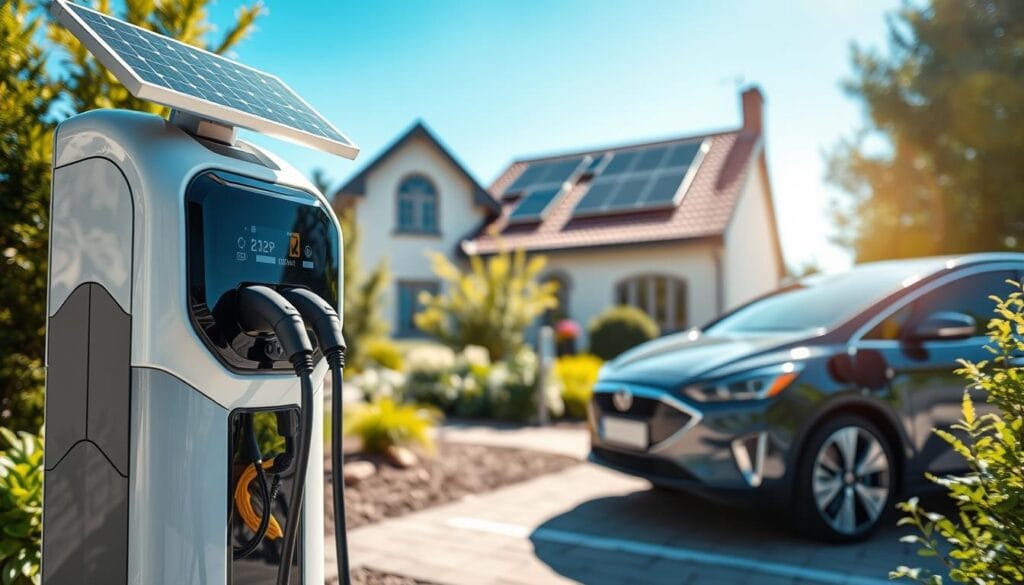
Homeowners often choose Level 2 for its faster charging. But, your choice depends on your driving habits, EV type, and solar power capacity.
Setting Up Your Solar EV Charging Station
Setting up a solar EV charging system at home needs careful planning. You must assess your energy needs, choose the right solar panel and EV charger, and ensure a safe installation.
Step-by-Step Installation Guide
To install your home solar car charger, follow these steps:
- Assess your energy needs: Figure out how much energy you need to charge your EV and how much solar power you can get.
- Choose your solar panel system: Pick a solar panel system that fits your energy needs and works with your EV charger.
- Select your EV charger: Choose a Level 2 EV charger that matches your vehicle and solar panel system.
- Install the solar panel system: Mount the solar panels on your roof, making sure they are secure and in the best spot.
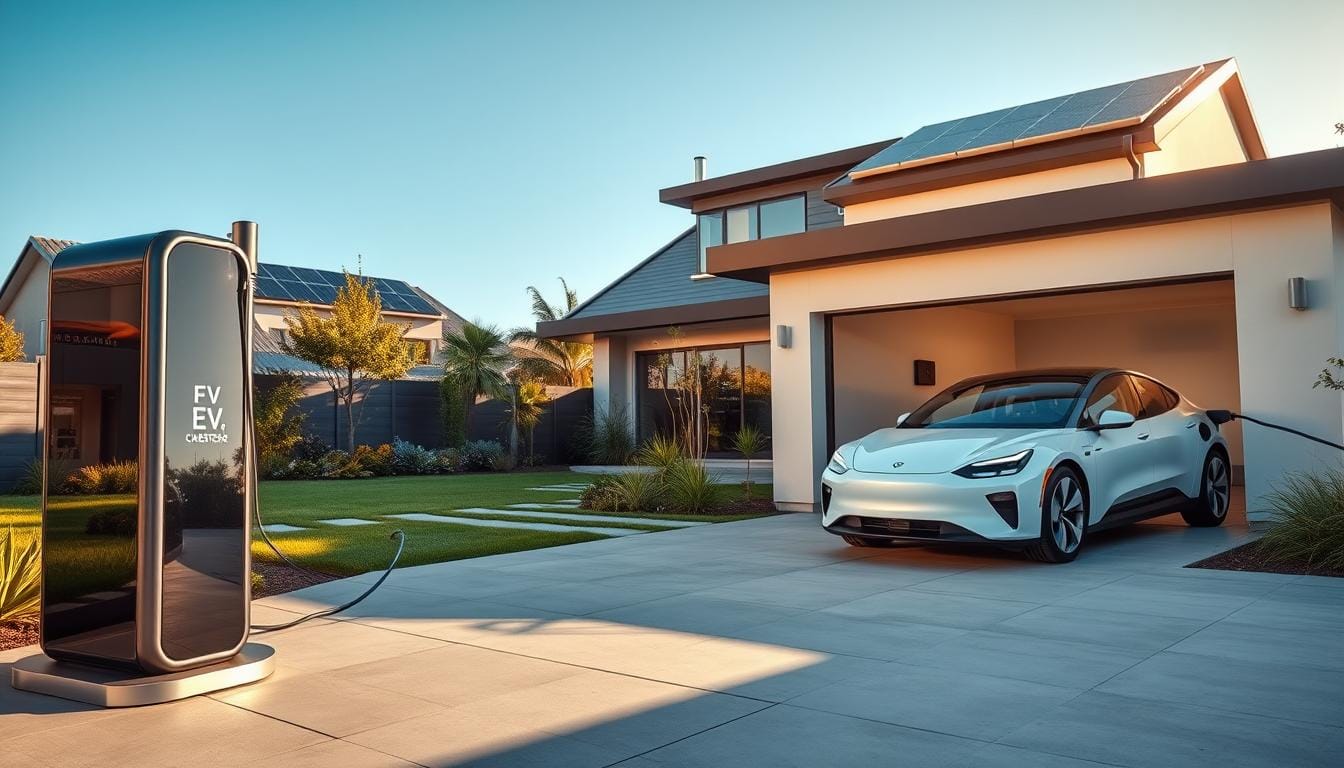
- Install the EV charger: Put the EV charger in a good spot, like your garage, and connect it to your solar panel system.
- Connect to your electrical panel: Connect your solar panel system to your home’s electrical panel for safe and efficient energy.
Important Safety Considerations
When setting up your solar EV charging system, safety is key. Here are important things to remember:
- Electrical safety: Make sure all electrical connections are secure and follow local electrical codes.
- Proper grounding: Make sure your solar panel system and EV charger are grounded to avoid electrical shock.
- Fire safety: Keep flammable materials away from your solar panel system and EV charger.
- Regular maintenance: Check your solar panel system and EV charger often to make sure they are working right and safely.
By following these guidelines and keeping safety in mind, you can have a reliable and efficient home solar car charger.
Cost Breakdown of Solar Powered EV Chargers
Thinking about getting a solar-powered electric vehicle charger? It’s key to know the costs involved. This knowledge will help you decide if it’s a good fit for you.
Initial Investment Costs
Getting a best home ev charger solar powered system starts with a few things. The cost to install a solar panel system is about $15,000 to $25,000. This includes the panels, inverter, mounting gear, and the work to put it all in place.
Here’s what you might pay for:
- Solar panels: $8,000 to $12,000
- Inverter: $1,000 to $2,000
- Mounting hardware: $1,000 to $2,000
- Installation labor: $3,000 to $5,000
- Permits and inspections: $500 to $1,000
A recent study found that solar panel costs have dropped by over 70% in ten years. This big drop makes solar-powered EV chargers a great choice for many homeowners.
Ongoing Maintenance Expenses
The upfront cost is big, but there are also ongoing costs. These are usually less than what you’d pay for traditional energy.
Some ongoing costs include:
- Maintenance and repair: $100 to $300 per year
- Inverter replacement: $1,000 to $2,000 every 10 to 15 years
- Monitoring system: $100 to $500 upfront, with possible ongoing fees
“Investing in a solar-powered EV charger not only reduces your carbon footprint but also provides long-term financial benefits.” –
Knowing both the upfront and ongoing costs helps you decide if a solar-powered electric vehicle charger is right for your home.
Calculating Your Return on Investment (ROI)
Thinking about getting a solar powered EV charger? Knowing the ROI is crucial. It shows the financial gains of using a green home charging station.
Key Factors Influencing ROI
Several things affect the ROI of your solar panel EV charger. These include:
- The initial cost of the solar panel system
- The cost of electricity in your area
- The amount of solar energy your system makes
- Any incentives or rebates you can get
The initial investment in a solar powered EV charger is big. But, it’s balanced by long-term savings on your electricity bills.
How to Calculate Your Savings
To figure out your savings, compare your current electricity costs to what they’ll be after installing the solar system. Here’s how:
- Find out your current annual electricity costs.
- Calculate your annual electricity costs after installing the solar system.
- Subtract the new costs from the current costs to find your annual savings.
For example, if your current annual electricity cost is $1,500 and the cost after installing the solar system is $500, your annual savings would be $1,000.
“The ROI on solar powered EV chargers can be significant, thanks to rising electricity costs,” says an industry expert. “Homeowners can save thousands of dollars over their solar system’s lifespan.”
By knowing what affects ROI and how to calculate savings, you can decide wisely about getting a solar powered EV charger for your home.
Electric Vehicle (EV) Compatibility
When thinking about an eco-friendly solar EV charger, check your electric vehicle’s charging needs. Your EV must match the solar charger’s capabilities. This includes the vehicle type, battery size, and charging speed.
Assessing EV Charging Needs
Every electric vehicle has different charging needs. To find the right solar charger, look at your EV’s battery size and charging speed. Also, check the charging connector type. Some EVs need Level 1 (120V) charging, while others require Level 2 (240V).
Key factors to consider when assessing your EV’s charging needs include:
- Battery capacity and type
- Maximum charging speed
- Type of charging connector
- Charging level (Level 1 or Level 2)
Popular EV Models and Their Requirements
Many EV models have specific charging needs. For example, the Tesla Model 3 needs a Level 2 charger for fast charging. The Nissan Leaf can charge with either Level 1 or Level 2. Knowing these needs helps pick the right solar charger.
Here’s a brief overview of some popular EV models and their charging needs:
| EV Model | Charging Level | Maximum Charging Speed |
|---|---|---|
| Tesla Model 3 | Level 2 | 7.6 kW |
| Nissan Leaf | Level 1/Level 2 | 6.6 kW |
| Chevrolet Bolt | Level 2 | 7.2 kW |
By knowing your EV’s charging needs and comparing them with your solar charger, you can charge efficiently. This ensures you get the most from your eco-friendly solar EV charger.
Local Incentives and Rebates
Getting a solar-powered EV charger for your home can be cheaper than you think. Many local incentives and rebates help make it more affordable. If you’re thinking about getting a solar electric vehicle charging station, you might get financial help that lowers the cost upfront.
Federal Incentives for Solar Installation
The federal government has a tax credit for solar installations, including EV chargers. This credit can cover up to 26% of the total cost. You need to own your home and have enough taxes owed to qualify. The credit is good until December 31, 2032, then it drops to 22%.
Key benefits of the federal tax credit include:
- It can lower your federal taxes a lot
- There’s no limit to how much you can claim
- You can get it for both your main and secondary homes
State-Specific Rebates and Programs
Many states also offer rebates and programs for solar-powered EV chargers. These incentives differ by state, so it’s key to check what’s available in your area.
Some states give rebates based on your solar system’s size. Others pay you for the energy your system makes. For example, you might get a rebate of $X per kWh of electricity your solar EV charger produces.
Popular state-specific programs include:
- California’s Self-Generation Incentive Program (SGIP)
- New York’s NY-Sun Incentive Program
- Massachusetts’s Solar Massachusetts Renewable Target (SMART) Program
To save the most, look into both federal and state incentives for your solar-powered EV charger.
By using these local incentives and rebates, you can cut down the cost of your solar-powered EV charger. This makes it a more practical and appealing choice for your home.
Future Trends in Solar Charging Technologies
Thinking about getting a home solar car charger? It’s key to know about the latest in solar charging tech. The field is always changing, with new ways to make solar EV charging better and easier.
Innovations in Solar Chargers
New tech is coming to make solar chargers work better. You’ll see solar panels that use energy more efficiently and smart systems that help make more power. These updates mean your solar car charger will help you use less grid power.
Smart Home Integration
Another big trend is linking solar chargers with smart home tech. This lets you watch and manage your energy use better. As smart home tech gets better, your solar charger will work even smoother with it.
Keeping up with these trends helps you get the most from your solar car charger. You’ll enjoy clean, green energy more than ever.