
Used EV Battery Health: How to Check a Battery Before You Buy
A used electric car can look pristine, drive quietly, and still have less usable range than its dashboard suggests. The question buyers really want answered is not simply whether an EV battery is “good,” but how much capacity remains, how reliably it performs, and whether the evidence is strong enough to support the asking price.
That is why used EV battery health deserves a careful check before you buy. A battery’s condition affects real-world range, charging behavior, resale value, and confidence in the vehicle. The good news: modern EV packs are engineered to last, and a sensible inspection combines the car’s own diagnostics with service records, a road test, and—when warranted—an independent battery report.
Here is how to understand battery state of health, what a seller’s number can and cannot tell you, and how to compare two used EVs without mistaking normal aging for a looming repair.
What “battery health” means on a used EV
An EV battery’s state of health (SOH) describes its present usable capacity compared with its capacity when new. If a pack originally offered usable energy of about 75 kilowatt-hours and now holds about 67.5 kWh under comparable conditions, its capacity-based SOH would be roughly 90%. It does not mean the battery is unsafe, nor does it directly state the vehicle’s remaining lifespan.
Battery capacity is only one part of the story. A good inspection also considers whether the pack charges normally, whether the cells are balanced, whether warning codes are present, whether temperature management works, and whether the vehicle has a documented repair history. A single percentage shown by a dashboard or scan tool may be an estimate calculated by the vehicle’s battery management system (BMS), not a laboratory measurement.
Also separate degradation from a defect. Gradual capacity loss is expected as a battery ages and cycles. A sudden loss, an unusually large difference between cells, repeated charging faults, or a high-voltage warning deserves more investigation. Range estimates can fall temporarily in cold weather, after a fast drive, or when climate control is running; those changes alone do not prove permanent battery damage.
What current battery data says about longevity
Large real-world datasets are more useful than dramatic anecdotes, but averages are not promises for an individual car. In an analysis of more than 22,700 EVs across 21 models, Geotab reported an average annual capacity degradation rate of 2.3% in its updated dataset. It also emphasized substantial differences by model, charging patterns, climate, and use. The study projected an average of about 81.6% capacity remaining after eight years, but that is a cohort-level projection—not a pass/fail threshold for every vehicle.
Geotab’s data found that vehicles relying on DC fast charging more frequently tended to degrade faster on average, especially when a large share of those sessions used power above 100 kW. The comparison groups in that study are not a diagnostic formula for a particular car: battery chemistry, thermal management, software, and how the car was operated all matter. Fast charging is a useful tool for trips; the evidence does not mean an occasional rapid charge ruins a pack.
The same analysis found a modest annual degradation difference for vehicles operating in hotter climates, while time spent near the top or bottom of charge became more important when exposure was habitual and prolonged. In other words, avoid leaving a vehicle parked for long periods nearly full or nearly empty when practical, but do not panic over a one-off 100% charge before a trip. Follow the automaker’s guidance for the specific battery chemistry and model.
These findings can help buyers ask better questions, not predict an exact battery life. One reason online EV forums are full of questions about “100% SOH” readouts is that owners and shoppers want a simple answer. Treat any single reading—whether reassuring or alarming—as a clue that needs context.
How to check used EV battery health: a buyer’s checklist
1. Ask for the exact battery and warranty details
Start with the vehicle identification number (VIN), model year, trim, original battery size, and the manufacturer’s warranty terms. Coverage varies by automaker, model, market, and sometimes battery chemistry. Check the warranty booklet or official manufacturer site for the time and mileage limits, what capacity loss is covered, and any exclusions. Do not assume that a warranty transfers automatically or that a remaining warranty guarantees replacement for ordinary range loss.
Ask the seller for maintenance and repair records, including battery or charging-system work, software updates, collision repairs, and any high-voltage warning diagnosis. Confirm open recalls with the manufacturer using the VIN. If a battery component was replaced, ask whether the paperwork identifies the pack, module, or other part and whether the repair is covered by a separate warranty.
2. Request a BMS or diagnostic report
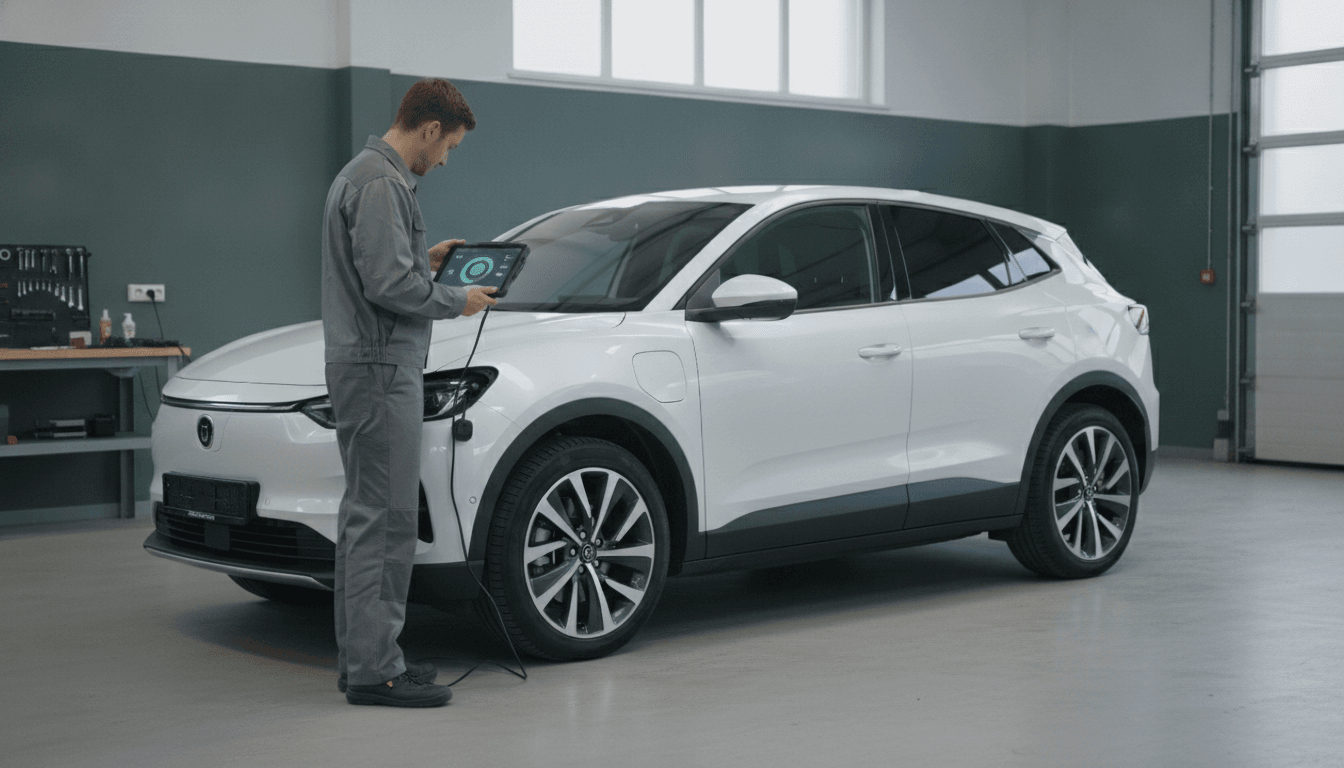
Ask whether the vehicle can provide a battery capacity or SOH report through its built-in service menu, a dealer diagnostic, or a reputable independent EV inspection service. The best report identifies the test method, date, mileage, relevant fault codes, and—where available—cell or module balance. A bare percentage without a method, vehicle context, or supporting data is less persuasive.
Not every automaker exposes the same data to owners, and third-party scan tools can differ in what they calculate. Some readings are model-specific estimates that change after updates or recalibration. Ask the technician to explain whether the reported figure is measured capacity, BMS-estimated SOH, or an inference based on range and energy use. Do not compare percentages from different tools as if they were standardized laboratory results.
3. Compare range carefully—not just the dashboard number
The range shown at startup is often called the “guess-o-meter” for a reason: it estimates distance using recent driving, temperature, speed, terrain, and accessory use. A low estimate after winter highway driving may reflect conditions rather than a damaged pack. Conversely, a high estimate after gentle city driving is not proof that full original capacity remains.
During a test drive, note the starting and ending state of charge, distance, outside temperature, route, speed, and climate-control use. Look for a range estimate that changes in a plausible way and for any sudden percentage drops or power limitations. This is a screening check, not a precise capacity test: short drives, steep routes, and changing weather make simple range arithmetic unreliable.
4. Test charging and inspect for warning signs
If possible, test both AC charging and DC fast charging, or have an EV-qualified technician do so. Confirm that the vehicle starts and sustains a charge, the connector locks properly, and there are no charging or high-voltage warnings. Charging speed varies with battery temperature, current state of charge, charger capacity, and vehicle limits, so one slow session does not automatically indicate a faulty battery.
Watch for warning lights, repeated charging interruptions, unexplained loss of power, unusual battery temperature messages, or a persistent mismatch between displayed charge and usable driving. Do not attempt to open or inspect a high-voltage battery pack yourself. If there are signs of damage, flooding, fire exposure, or an unresolved warning, make the purchase conditional on a qualified inspection—or walk away.
5. Get an independent inspection when the stakes justify it
For an expensive vehicle, a high-mileage example, a car near the end of its battery warranty, or a seller who cannot provide clear records, an independent EV pre-purchase inspection can be money well spent. Choose a shop experienced with the specific make and model. Ask for a written report covering diagnostic trouble codes, battery health method, pack condition, charging operation, cooling system, and any repair estimate.
Make sure the inspection is performed with the seller’s permission and that the report’s limitations are clear. A diagnostic snapshot cannot guarantee future performance or reveal every internal issue. It does, however, reduce uncertainty and gives you a stronger basis for comparison and negotiation.
How to interpret the results—and compare two cars
There is no universal SOH percentage that makes every used EV a good or bad purchase. A pack at 90% may be a sensible buy if the price, range, warranty, and records fit your needs. Another vehicle with a higher reported number may be a poor choice if it has unexplained faults, a damaged charging system, or an unreliable report. Ask the dealer or specialist how the reading compares with typical examples of the same model and age, and request the basis for that comparison.
Build a like-for-like comparison: same model and battery version, similar age and mileage, similar climate, and the same testing method. Then consider usable range for your routine rather than chasing a perfect percentage. If you commute 35 miles a day and have home charging, a moderate reduction may have little effect. If you regularly drive long rural routes in winter, the same reduction could matter more.
Estimate total ownership cost alongside battery condition. Include purchase price, insurance, tires, charging access, likely maintenance, and the cost of a home charging setup if needed. Do not assume a complete battery replacement is imminent simply because capacity has declined; equally, do not treat a warranty as a substitute for inspecting a car that already shows symptoms.
Battery-care claims buyers should put in context
“The car was fast-charged, so the battery must be bad.” Not necessarily. Charging history matters, but so do pack design, temperature control, frequency, and how long the vehicle sat at extreme charge levels. Ask for the full picture and inspect the actual vehicle.
“It reached 100%, so it has 100% health.” No. State of charge describes how full the battery is right now; state of health estimates how its capacity compares with when new. Those are different measurements.
“A low range estimate proves battery failure.” Also no. Weather, speed, hills, tires, and recent driving can all change the estimate. Look for a persistent pattern and pair it with a diagnostic report.
“The battery warranty means there is no risk.” Warranty coverage is helpful, but terms vary and typically include conditions. Confirm eligibility, remaining time and mileage, capacity thresholds if any, and transfer rules in writing.
A practical decision rule for used EV shoppers
Before committing, aim to leave with four things: a vehicle-specific warranty answer, a credible battery-health assessment, a clean diagnostic and charging check, and a realistic estimate of range for your climate and routine. If one piece is missing, decide whether an independent inspection or a lower price adequately addresses the uncertainty. If the seller refuses reasonable checks or cannot explain serious warning signs, do not let a low price rush you.
Used EV battery health is not a mysterious pass-or-fail number. It is a combination of remaining usable capacity, reliable operation, warranty protection, and fit for your driving life. Modern battery data is encouraging, but the smartest purchase still comes from checking the individual car rather than relying on averages or forum anecdotes.
Takeaway: Ask for a documented, model-appropriate battery report, test the car’s charging and driving behavior, verify its warranty, and compare range needs honestly. A careful inspection can turn battery uncertainty into a clear, confident buying decision—and help you choose an electric car that supports lower-emission travel for years to come.
Sources: Geotab’s 2026 analysis of EV battery health; Recurrent’s 2026 EV market and trends report; IEA, Global EV Outlook 2026: Electric vehicle batteries. Statistics describe study populations and do not predict the condition of an individual vehicle.